
Let’s be blunt: your dashboards are telling you the past.
You’ve spent the last decade chasing “analytics.” You’ve built impressive BI (Business Intelligence) systems that show you, in excruciating detail, what happened last quarter, last week, or even last hour.
But they can’t tell you why.
And they certainly can’t tell you what to do next.
This is the hard wall most companies hit. You’re drowning in data but starving for actual knowledge. You’re stuck in a loop of reporting, not reasoning. If you want to build an intelligent enterprise—one that can predict and act—you have to move beyond analytics. You have to build systems that think.
The Shift from Reporting to Understanding
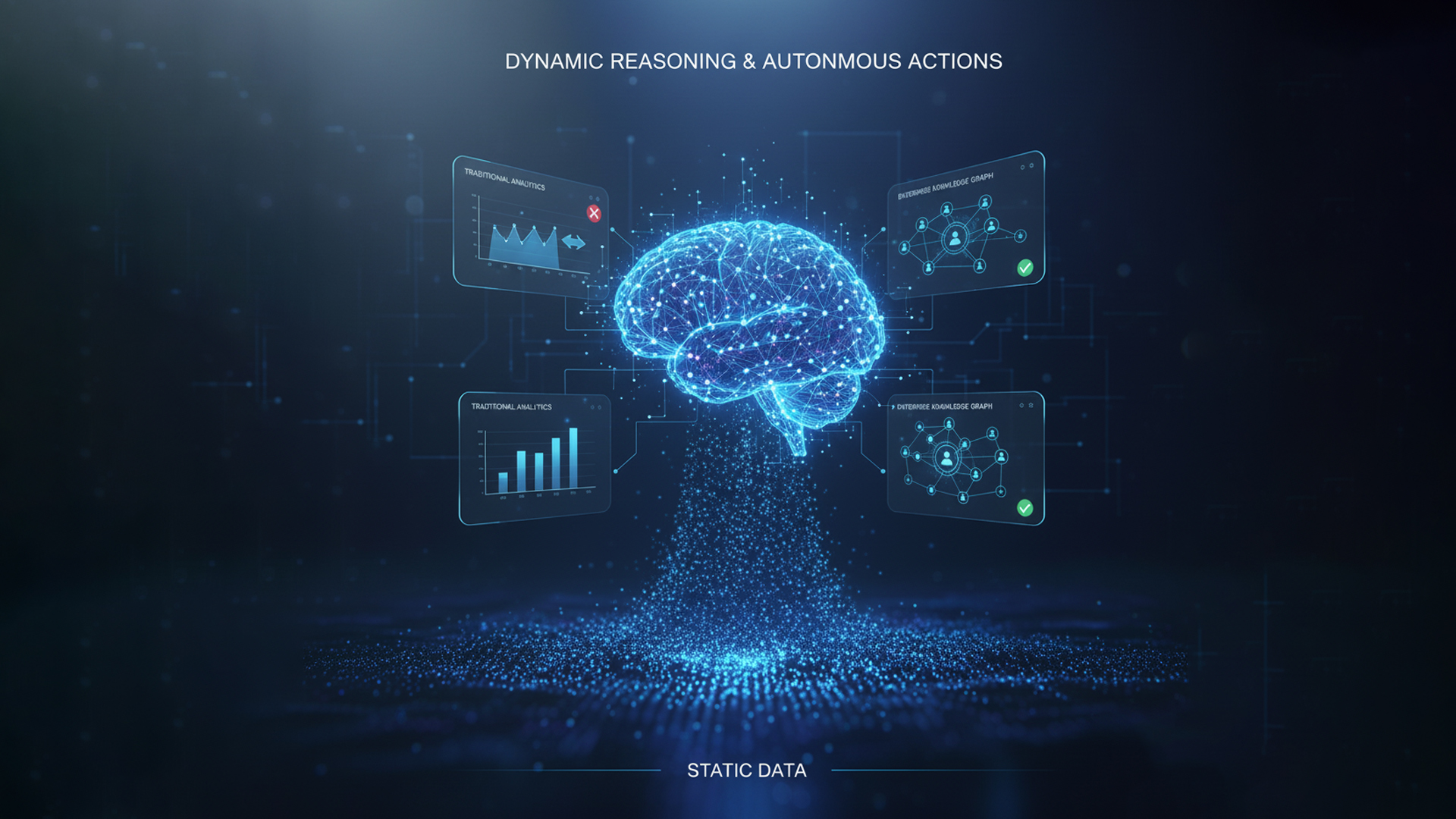
Traditional BI is a passive, one-way street. It’s a mirror. It reflects a number: “Sales dropped 15%.”
An intelligent, knowledge-first AI is an active, dynamic system. It’s a brain. It provides understanding. It tells you: “Sales dropped 15% in the-Midwest… because a new competitor’s ad campaign launched in that region, which coincides with a 40% spike in support tickets mentioning ‘pricing,’ and this exact pattern was seen in the UK last quarter.”
See the difference? One is a number. The other is an answer.
The failure of traditional BI is that it ignores the most valuable part of your data: the context and the relationships. The “intelligence” isn’t in the number 15. It’s in the connection between the sales drop, the ad campaign, and the support tickets.
What Makes a Knowledge Graph Powerful
So, how do you build this “brain”? The core technology, and the one your team needs to be focused on, is the Enterprise Knowledge Graph.
If you’re new to the term, here’s a simple analogy.
- A traditional database is a set of filing cabinets. Your customer data is in one, your support data is in another, and your product data is in a third. They’re all separate.
- An Enterprise Knowledge Graph isn’t a cabinet; it’s a living web. . It’s a single, unified map of your entire business and it’s built on relationships.
This graph provides two critical things:
- A Unified Data Representation: It connects
Customer: Jane DoetoSupport Ticket: #812toProduct: Pro PlantoInvoice: #4561. All the fragmented pieces of your business are suddenly connected. - Semantic Understanding for Agents: This is the most important part. An AI agent can finally reason. It doesn’t just see a text string
"Jane Doe". It understands thatJane Doeis a “Customer” who is “Subscribed to” the “Pro Plan” and “Has an Open” “Support Ticket.” The graph provides the context for the AI to “think” intelligently.
Turning Insights into Actions
This is where everything changes. When your AI can understand these relationships, it can finally take action.
Let’s make this practical. When we at UniProAI design a cognitive system, we don’t just point an LLM at a pile of raw data. That’s a recipe for hallucination and failure. We first build the knowledge graph.
Here’s the use case: A customer emails, “Where is my order?”
- The Dumb Bot (No Graph): “Please provide your 10-digit order number.” (Useless).
- The Smart Agent (With Graph): The agent receives the email. It queries the graph and instantly knows who the customer is, finds their most recent order, sees its status is “Delayed,” and checks their subscription “VIP” status.
The insight (VIP customer has a delayed order) is instSntly connected to the action. The agent doesn’t ask a stupid question. It replies, “Hi Jane, I see your order #1234 is delayed. I’ve automatically upgraded it to overnight shipping. As a VIP, I’ve also applied a $25 credit to your account for the trouble.”
You have just closed the loop between insight and action.
The Rise of Self-Evolving Knowledge Systems
This is all powerful, but it gets even better. Right now, building these graphs is a major project. The future, however, is one of self-evolving knowledge systems.
This is where we use AI agents as knowledge curators.
Imagine an agent that reads all new sales transcripts and support tickets. It detects a new, emerging pattern—a relationship that isn’t in the graph yet. For example, “Customers who mention ‘Feature X’ are 40% more likely to ask about ‘Competitor Y’s pricing’.”
The agent doesn’t just file a report. It proposes an update to the knowledge graph, creating a new, dynamic link. Your knowledge system is no longer a static map; it’s a living, breathing part of your team, learning and growing as your business learns.
Your Key Takeaway
For the last 20 years, we’ve been told “data is the new oil.” It’s a tired, passive-voice metaphor. Data is just the raw material.
Knowledge is the new competitive advantage.
Knowledge that deep, contextual, connected understanding of why things happen is the refined fuel. It’s what will power every intelligent agent, every automated workflow, and every meaningful customer experience you build from this day forward. Stop reporting, and start reasoning.
For more deep dives and original AI analysis, visit uniproai.com and subscribe to our research briefs.